Reverse osmosis drinking water in Collin County
The end of hauling cases of bottled water in from the car. An under-sink RO system gives you genuinely clean drinking and cooking water at the kitchen tap — and it's the least expensive piece of water treatment most homes here will ever buy.
How it's different from a filter
A carbon filter works by adsorption — contaminants stick to the carbon as water passes through. That's effective for chloramine, taste, and odor, but dissolved minerals and metals go straight through it.
Reverse osmosis works by exclusion instead. Household water pressure pushes water through a semi-permeable membrane with pores measured in ten-thousandths of a micron. Water molecules fit. Almost nothing else does. What's rejected gets rinsed to the drain.
The practical result: RO reduces dissolved solids broadly, which means it also handles lead, arsenic, nitrates, fluoride, and PFAS — things carbon alone doesn't touch. A real system is a series of stages: sediment pre-filter, carbon pre-filter, the membrane, a storage tank, and a post-filter that polishes taste on the way to the faucet.
Check the certification, not the marketing. Look for NSF/ANSI 58, the standard for residential RO — and read which specific contaminants the certification covers, because it varies by system. "Filters up to 99% of contaminants" on a box means nothing on its own.
Why RO and a softener belong together
These two get pitched as alternatives. They're not — they solve problems at opposite ends of the house.
RO treats one tap. Excellent water for drinking, coffee, ice, and cooking. It does nothing about the scale accumulating in your water heater or the film on your shower glass, because every other fixture in the house is still running untreated water.
A softener treats the whole house but leaves dissolved solids in the water, so it improves how water behaves without much changing how it tastes.
There's also a practical reason to install them together: on 11.8-grain water, hardness minerals scale an RO membrane and shorten its life considerably. Feeding the system softened water roughly doubles membrane life — typically from about two years to four or five. If you're installing both, do the softener first or at the same time.
What installation involves
The system lives in the sink cabinet: a manifold of filter housings, the membrane, and a small pressurized storage tank. Most installs take two to three hours.
The faucet
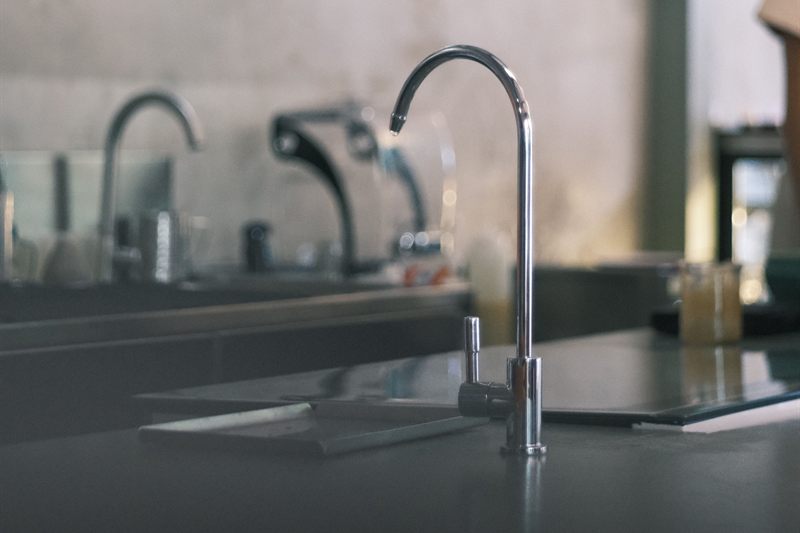
RO water comes out its own dedicated faucet, separate from your main one. If your sink has a spare hole — common where a soap dispenser or sprayer used to be — it goes there. If not, we drill one. Stainless and matte black finishes are standard; matching an unusual finish can add a little to the cost.
The drain and supply
A saddle clamp on the drain line carries the reject water away, and the cold supply is tapped with a feed valve. Both are standard connections, and both are places cheap installs cut corners — a poorly seated drain saddle is the most common source of the slow under-sink leak people discover months later.
Refrigerator and pot-filler lines
Worth asking about while the cabinet is open. Running RO water to the fridge means clean ice and cold water without a separate filter cartridge, and it's much cheaper to do during the original install than as a return visit. A long run to a fridge on the far side of the kitchen may need a permeate pump to keep pressure up.
Maintenance and running costs
| Component | Replace | Notes |
|---|---|---|
| Sediment pre-filter | 6–12 months | Protects everything downstream |
| Carbon pre-filter | 6–12 months | Strips chloramine before it reaches the membrane |
| RO membrane | 2–5 years | Longer on softened water, shorter on hard |
| Post-filter | Annually | Final taste polish |
Budget roughly $80 to $150 a year in filters. Compare that against a family buying bottled water and it usually pays for itself inside the first two years.
On waste water: older RO systems sent four or five gallons to drain for every gallon produced. Modern membranes and a permeate pump bring that closer to one or two to one, and softened feed water improves it further. It's worth asking what ratio a quoted system actually runs at.
What it costs
Under-sink RO installs in Collin County run $400 to $1,500 — the widest relative range of anything we install, because the systems themselves vary so much. What moves the price:
- Stage count and membrane quality — a 4-stage system with a certified membrane versus a basic 3-stage.
- Permeate pump — improves efficiency and pressure, adds cost.
- Faucet finish — standard finishes are included; matching an unusual one costs more.
- Drilling a new sink hole — straightforward in stainless, more involved in granite or quartz.
- Fridge or pot-filler line — cheap during install, expensive as a separate trip.
Full pricing for every system type is in the Collin County cost guide.
Common questions
What does RO remove that a carbon filter doesn't?
Dissolved solids — so lead, arsenic, nitrates, fluoride, and PFAS, on top of the taste and odor carbon already handles. Look for NSF/ANSI 58 certification and check which contaminants it actually covers.
Does it waste a lot of water?
Less than it used to. Older systems ran 4–5 gallons to drain per gallon produced; modern ones with a permeate pump run closer to 1–2 to 1, and better still on softened water.
Do I still need a softener?
If scale, spots, and appliance wear bother you, yes — RO only treats one tap. And softened feed water roughly doubles how long your RO membrane lasts, so the two work better together.
How often do filters need changing?
Pre-filters every 6–12 months, post-filter annually, membrane every 2–5 years. Roughly $80–$150 a year.
Can I run it to my refrigerator?
Yes, and it's far cheaper to do during the original install than as a return trip. Long runs may need a permeate pump to keep pressure up at the fridge.
Get a free RO quote
We'll look at your sink, your cabinet space, and whether a fridge line makes sense while we're in there. Free, in writing, no obligation.
Or request a quote online — we usually call back the same day.