
Water softener installation in Collin County
Our water runs about 11.8 grains per gallon — "very hard" by every standard, and hard enough that scale starts working on a brand-new water heater the week you move in. A correctly sized softener stops it. Here's how sizing actually works, what installation day looks like, and what it costs.
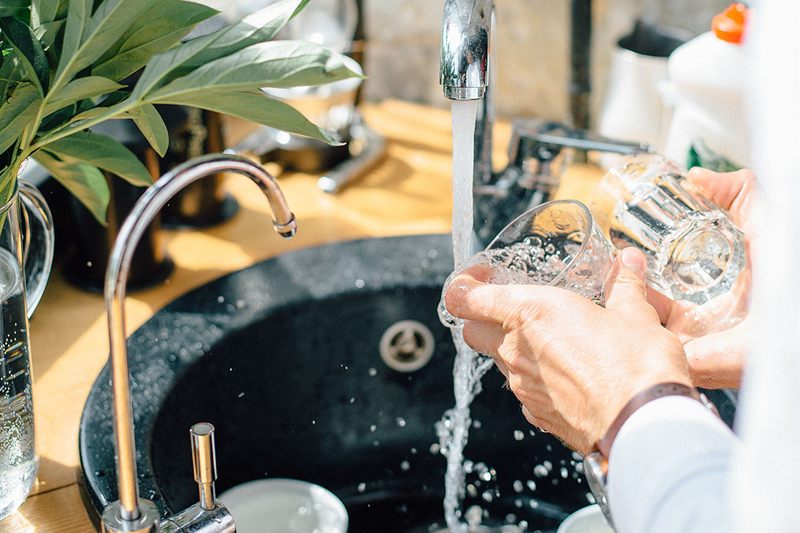
What a softener actually does
Hardness is dissolved calcium and magnesium — minerals North Texas limestone puts into every drop of water that reaches your house. A softener runs that water through a tank of resin beads that hold sodium ions. The calcium and magnesium trade places with the sodium, and what comes out the other side has essentially no hardness left in it.
When the resin fills up with hardness minerals, the system flushes itself with brine from the salt tank, rinses the minerals down the drain, and starts over. That's regeneration, and on a properly sized system it happens about once a week in the middle of the night.
This is the only thing that removes hardness. Filters don't do it, and neither do the magnetic or electronic "descalers" sold online — those claim to change how scale forms, but the calcium is still in your water. If the problem is spots, scale, and crusty fixtures, a softener is the fix.
Sizing it for 11.8-grain water
Sizing is the part most people never get told about, and it's where most bad installs go wrong. The math isn't complicated:
People × 75 gallons per day × 11.8 grains = grains removed per day.
A family of four comes to about 3,540 grains a day, or roughly 25,000 grains a week. You want a system that handles a week of that between regenerations — which is why most Collin County households of three to five people land on a 48,000-grain system, not the 32,000-grain unit that's the default at big-box stores.
| Household | Grains per day | Typical system |
|---|---|---|
| 1–2 people | 1,800–2,100 | 32,000 grain |
| 3–4 people | 2,700–3,600 | 48,000 grain |
| 5–6 people | 4,400–5,300 | 64,000 grain |
| Large home, high use | 6,000+ | 80,000 grain or twin tank |
Why undersizing costs you money. A system that's too small regenerates every two or three days instead of weekly. That means more salt, more water down the drain, and resin that wears out years early. Oversizing has its own problem — resin that sits too long between regenerations channels and loses efficiency. The right size is the one matched to your actual household, which is why we ask before we quote.
Does your home have a softener loop?
Most homes built in Collin County in the last twenty years have one — a pre-plumbed bypass in the garage, usually two capped copper or PEX stubs with a loop of pipe between them. Builders in Frisco, Prosper, and Celina put them in almost universally. It means the plumbing for a softener is already done.
With a loop: we connect to the existing stubs, set the tanks, run a drain line, and program the valve. Two to three hours, no pipe cutting, no drywall.
Without a loop: common in older homes in Allen and central McKinney. We cut into the main line where it enters the house, add a bypass valve so the system can be serviced without shutting off water, and run a drain. Four to six hours, and it adds several hundred dollars to the job.
Not sure what you're looking at? Send us a photo of the garage wall near the water heater and we'll tell you.
What installation day looks like
We test and confirm
Hardness test on your actual tap, a look at your loop or main line, and confirmation of the size we quoted before anything comes off the truck.
Set and plumb
Tanks positioned, connected to the loop or main, drain line run to a standpipe or floor drain, bypass valve fitted so the system can be serviced later.
Program and flush
Valve programmed to your hardness and household size, first regeneration run, lines flushed, and every connection checked under pressure.
Walkthrough
We show you the bypass, how to add salt, what the display means, and when to expect the first refill. You get the manual and the warranty in writing.
Living with a softener
Salt
Check the brine tank every month or two and keep it about half full. A correctly sized system for a family of four uses eight to ten 40-pound bags a year — roughly $70 to $120 annually at local prices. Solar crystals or pellets both work; pellets bridge less in humid garages.
What you'll notice in the first week
Soap lathers more and rinses cleaner, so most people cut their detergent and shampoo use by about half. Shower glass stops filming. Skin feels less dry. The slippery feeling in the shower is normal — that's soap rinsing completely instead of leaving a film of soap scum behind.
Service life
Resin lasts ten to fifteen years on chloraminated water. Valves are the part that eventually needs service. A well-maintained system is a fifteen-year appliance, not a five-year one.
Drinking water note. Softening trades hardness minerals for a small amount of sodium — about 200 mg per gallon on our water, less than you'd get from a slice of bread. If anyone in the house is on a sodium-restricted diet, we can run potassium chloride instead, leave the kitchen cold tap unsoftened, or pair the softener with a reverse osmosis system at the kitchen sink.
What it costs
Most Collin County softener installs land between $1,500 and $3,500, installed. The spread comes down to system size, whether you have a builder loop, and valve quality. We break the whole thing down — including what drives the high end and what to watch out for — in our Collin County water softener cost guide.
Every quote we give is free, in writing, and itemized. We'll also tell you when you don't need something.
- Cost guideReal price ranges, what drives them, and the sales tactics to walk away from.
- Add whole-house filtrationCarbon filtration for the chloramine taste softeners don't touch.
- Add reverse osmosisUnder-sink drinking water, and it pairs well with a softener.
- On a well?Testing comes first — well water needs a different system entirely.
Common questions
What size water softener do I need in Collin County?
Multiply people × 75 gallons a day × 11.8 grains. A family of four comes to about 3,540 grains per day, or 25,000 a week. On water this hard most families land on a 48,000-grain system, which regenerates roughly weekly rather than every other day.
How long does installation take?
Two to three hours with a builder loop. Four to six without one, since the main line has to be cut and a bypass added.
How much salt will it use?
Eight to ten 40-pound bags a year for a family of four on a correctly sized system — roughly $70 to $120. A softener eating far more than that is usually undersized or regenerating on a timer instead of on demand.
Will my water taste salty?
No. The salt recharges the resin; it doesn't go into your drinking water. What ends up in softened water is about 200 mg of sodium per gallon — less than a slice of bread.
Do I still need a filter if I have a softener?
They do different jobs. A softener removes hardness. It does nothing for the chloramine taste NTMWD uses to disinfect. If the water tastes or smells like a swimming pool, that's a carbon filtration question, and combo systems handle both in one footprint.
Get a free softener quote
We'll size it to your household, tell you what your loop situation means for the price, and put it in writing. No pressure, no obligation.
Or request a quote online — we usually call back the same day.